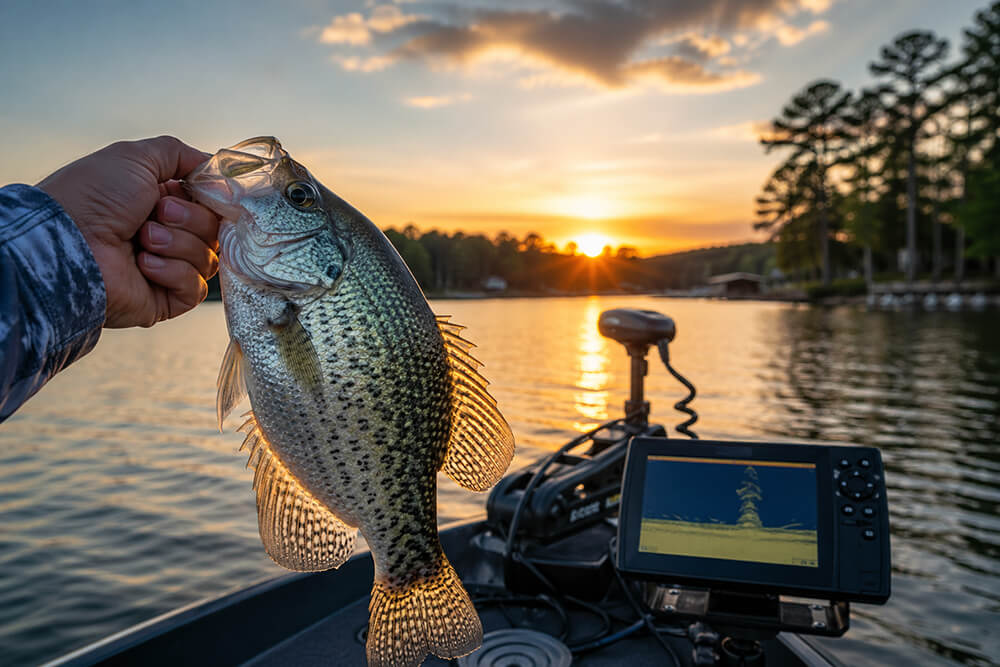
If you have watched a few fishing videos lately, it can feel like everyone catching slabs has forward-facing sonar on the bow. That can make a normal trip feel “behind” before you even launch.
Here is the honest answer for Crappie Fishing in Lake Oconee: you can absolutely catch crappie without forward-facing sonar. It is a tool, not a requirement. The real question is whether it fits your budget, your style, and how you like to fish.
If you want a bigger-picture read to set the scene, the best for your introduction is: Why Lake Oconee is the Crappie Fishing Capital of Georgia?
First, the Georgia rules you should know
- Crappie daily limit: 30 (black and or white).
- Fishing license: Required for most anglers age 16 and older in Georgia public waters.
About electronics: Georgia’s fishing methods rules include language that it is illegal to use “electronic devices” to take fish. That is aimed at illegal harvest methods (for example, shocking fish), not at standard fish-finder use for locating fish. If you fish any tournaments, also remember tournament rules can be stricter than state rules and vary by trail.
What forward-facing sonar actually does for crappie
- Traditional sonar shows what is under the boat.
- Forward-facing sonar shows what is in front of the boat, in real time.
For crappie, that means you can often:
- See suspended fish before you drop a jig.
- Stay on the correct depth without guessing.
- Watch how fish react to your lure and adjust quickly.
It is not magic, but it can remove a lot of trial-and-error.
When forward-facing sonar helps the most on Lake Oconee
1) When crappie are suspended
2) When you are searching new water
3) When fish are pressured
If you want the best is: Seasonal Fishing Calendar for Lake Oconee: When to Target Each Species (it supports why behaviour changes across seasons).
When you do not need it at all
You usually do not need forward-facing sonar if:
- You are fishing docks and brush in predictable seasonal windows.
- You prefer simple vertical presentations and slow, steady coverage.
- You are booking a trip to learn patterns and locations rather than “video-game” fishing.
For this angle, the best is: What Crappie Fishing Techniques Work Best on Lake Oconee?
A quick decision guide
You might want forward-facing sonar if you often think:
- “I cannot tell if fish are here or not.”
- “I waste most of my trip searching.”
- “I want to target suspended crappie more confidently.”
You can skip it for now if you often think:
- “I just want consistent bites and a relaxing day.”
- “I fish the same areas seasonally and do fine.”
- “I would rather invest in better rods, line, and tackle first.”
What to use instead if you do not have forward-facing sonar
Affordable alternatives that still work
- 2D sonar and Down Imaging: Great for confirming cover and depth under the boat.
- GPS mapping: Helps you stay on contour breaks and return to productive areas.
- A depth-check system: Keeping your jig at the right depth is a bigger deal than many people realise.
A lot of anglers catch more crappie by improving depth control and presentation than by upgrading electronics.
Common questions anglers ask
“Will forward-facing sonar help me catch more crappie?”
“Is it worth it for a guided trip?”
For this part of the blog, the best is: Questions You Should Ask Before Hiring a Fishing Guide in Lake Oconee?
“Does it change what techniques I should use?”
Conclusion
If you want to plan a Lake Oconee Fishing Guide trip focused on crappie, reach out to your guide team and lock in dates that match the seasonal bite.