

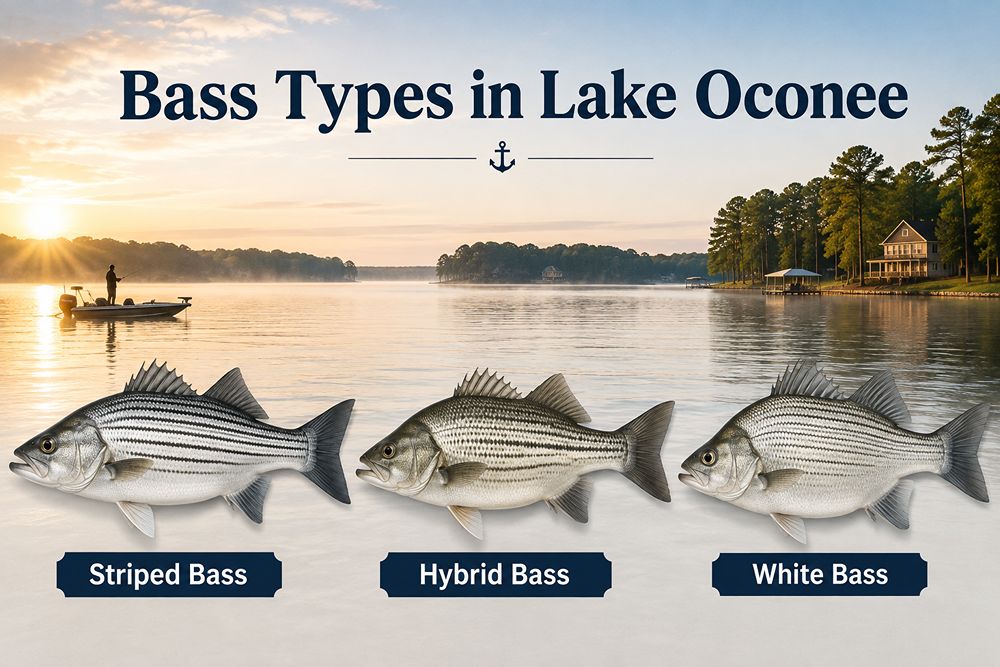
You hook a silver fish with dark horizontal stripes on Lake Oconee. Is it a striper, a hybrid, or a white bass?
It is an easy question to get wrong, especially when the fish are similar in size. Fortunately, a few physical clues can help anglers identify Striped Bass in Lake Oconee, hybrids, and white bass without relying on guesswork.
The Fastest Way to Compare the Three
| Feature | Brush piles | Hybrid Bass | White Bass |
|---|---|---|---|
| Body shape | Long and slender | Deeper, stockier body | Shorter, deep-bodied |
| Side stripes | Strong and mostly continuous | Strong but commonly broken | Usually faint |
| Tongue | Two tooth patches | Two tooth patches | One tooth patch |
| Second anal spine | 1/2 or less length of third | 2/3 or more length of third | 2/3 or more length of third |
| Typical appearance | Long, streamlined fish | Striper-like markings on a thick body | Compact, silvery fish |
Georgia DNR uses these same characteristics in its freshwater fish identification guidance.
Start With the Body Shape
A striped bass normally has a noticeably elongated, streamlined body. Larger stripers can look especially long compared with their depth.
Hybrid Bass in Lake Oconee tend to look thicker through the body. Their deeper, more arched shape reflects their striped bass and white bass parentage.
White bass are also deep-bodied, but they are generally smaller and more compact.
Anglers interested in how these fish move around the reservoir during different seasons can also read Where to Find Striped and Hybrid Bass in Lake Oconee Throughout the Year.
Look Closely at the Horizontal Stripes
Striped Bass
Hybrid Bass
White Bass
Lighting, fish size, and individual markings can make stripes harder to judge, which is why experienced Lake Oconee fishermen often check another feature before deciding.
Check the Tongue When the Fish Looks Similar
A striped bass has two tooth patches on its tongue.
A hybrid striped-white bass also has two tooth patches.
A white bass normally has one tooth patch.
That means the tongue is particularly useful for separating White Bass in Lake Oconee from the other two.
It does not fully solve the striper-versus-hybrid question, however, because both have two patches.
The Anal Spine Can Settle a Close Call
On a striped bass, the second anal spine is one-half or less the length of the third spine.
On both hybrid bass and white bass, the second anal spine is two-thirds or more the length of the third.
This feature takes a little more attention than checking stripes, but it can be valuable when identifying an unusual-looking fish.
Why Correct Identification Matters on Lake Oconee
Georgia currently groups striped bass, white bass, and hybrid white-striped bass under a combined daily limit of 15 fish. Of those 15, only two may be 22 inches or longer.
For a more detailed explanation of these harvest rules, see Can You Keep Hybrid Bass and Stripers from Lake Oconee?
Regulations can change, so anyone Fishing in Lake Oconee should review the latest Georgia DNR regulations before keeping fish.
Does the Time of Year Help with Identification?
Fish can school together or occupy similar areas, so assuming every fish in a school is the same species can lead to mistakes.
If you are planning around seasonal movement rather than identification alone, What Month is Best for Striper Fishing on Lake Oconee? provides useful trip-planning context.
A Three-Step Identification Routine
1. Check the shape.
2. Check the stripes.
3. Confirm with anatomy.
Using multiple features is much more reliable than judging the fish from stripes alone.
What If You Still Cannot Tell?
Take a clear photograph, compare the fish with Georgia DNR identification information, and release it if you are unsure whether keeping it would comply with current regulations.
Visitors planning a broader Lake Oconee Fishing Trip may also find Seasonal Fishing Calendar for Lake Oconee: When to Target Each Species useful for understanding when different fish are commonly targeted.