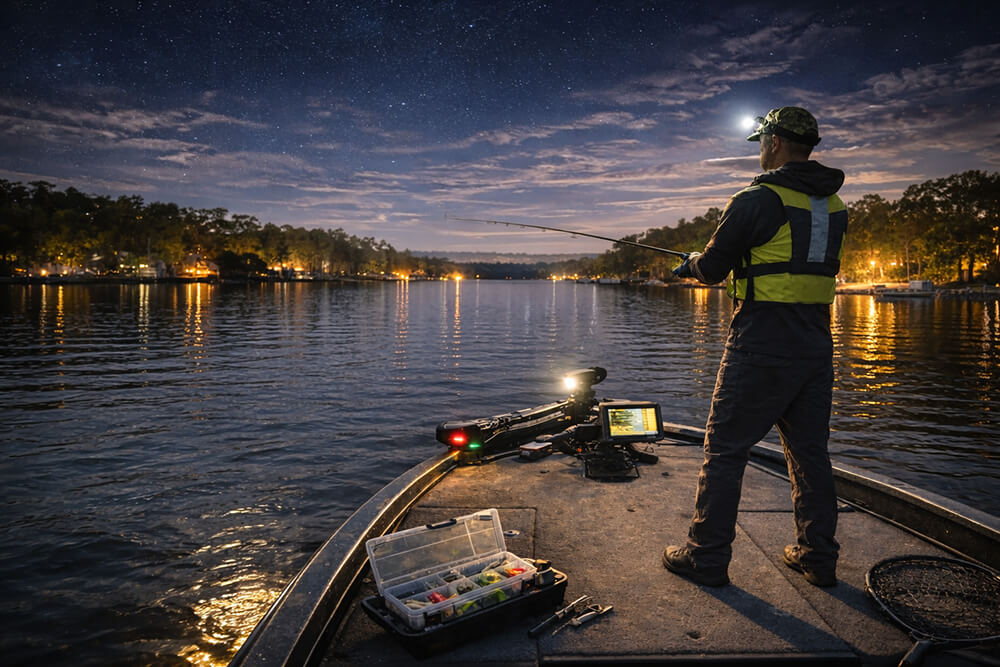
Night Fishing in Lake Oconee can be a completely different experience than fishing in the sun. The lake feels calmer, boat traffic often drops off, and in warm months the bite can pick up once the heat fades.
But it also comes with a few real-world challenges: visibility, navigation, gear organisation, and doing everything a little more safely and intentionally.
If you are thinking about Fishing in Lake Oconee after dark, here is what to expect, how to plan, and the Georgia rules that matter most.
What should you expect when fishing Lake Oconee at night?
You will rely on your ears as much as your eyes.
Your best spots may change.
Bites may feel different.
You will want a plan for bugs and humidity.
Preparation in Night Fishing starts before you leave the driveway
A simple night-fishing checklist that actually helps
Safety first
- Life jackets for everyone and worn when the boat is moving
- A fully charged phone in a dry case
- A basic first-aid kit
- A throwable flotation device on board
- A clear float plan shared with someone at home (where you launch, when you expect to return)
Navigation and visibility
- Working navigation lights (test before you launch)
- A spotlight or handheld flashlight for short checks (not constant shining)
- A headlamp for tying knots and handling fish
- GPS or mapping app, plus a backup battery pack
Fishing setup
- Pre-tied leaders or a few rigs ready to clip on
- One or two confidence lures, not ten different “maybe” choices
- A small tackle tray you can open with one hand
- A landing net if you expect larger fish or you are fishing with kids
Comfort
- A light jacket even in summer (it can feel cooler on open water)
- Water and a snack
- Bug spray
What Georgia rules matter most for night fishing on Lake Oconee?
1) Do you need a fishing license?
If you want a refresher, add an internal link to: “Stay Legal at Lake Oconee: A Complete Guide to Fishing Licenses and Regulations.”
2) What are the lighting rules on the water at night?
If you are on a boat, also keep an eye on Georgia DNR boating safety guidance and required equipment checklists, because night operation adds risk fast when visibility drops.
3) Can you use lights to help you catch fish?
For example, Georgia regulations explicitly discuss bowfishing hours and note that nongame fish may be taken at night using a light in reservoirs over 500 acres in certain circumstances.
If you are just rod-and-reel fishing at night, the big takeaway is: use lights for safety and visibility, and avoid assuming every light-based method is allowed for every species or technique.
How to choose a night spot on Lake Oconee without making it stressful
- Areas you have fished in daylight and understand well
- Wider water where you can see boat traffic coming sooner
- Banks you can follow without cutting across the lake repeatedly
- Spots away from heavy marina traffic late at night
If you already have a daytime seasonal pattern dialled in, link internally to: “What is Summer Fishing in Lake Oconee” to help readers connect daytime patterns to after-dark adjustments.
Common night-fishing problems and how to avoid them
I cannot see my line or my knots.
Boat wakes feel bigger at night.
I keep losing track of where I am.
I am worried about doing something illegal
A realistic “first night plan” for Lake Oconee
- Arrive before sunset and organise your deck while you can still see.
- Fish one main area for the first hour after dark, rather than bouncing around.
- Keep your lure selection simple until you learn what the night bite feels like.
- Set a turnaround time so you are not pushing fatigue at the end of the trip.
If you want to connect this topic to your broader site, add an internal link to: “Is There Good Fishing in Lake Oconee?” as a natural supporting read.
Conclusion: night fishing is calmer when you prepare for the dark, not just the bite
If you would like help planning a night trip that fits the season and conditions, reach out to your local Lake Oconee fishing team and get your trip set up with confidence.